The Student Loan Payoff Map
List every loan on its own line, see what each charges in interest, and send each extra dollar where it saves the most
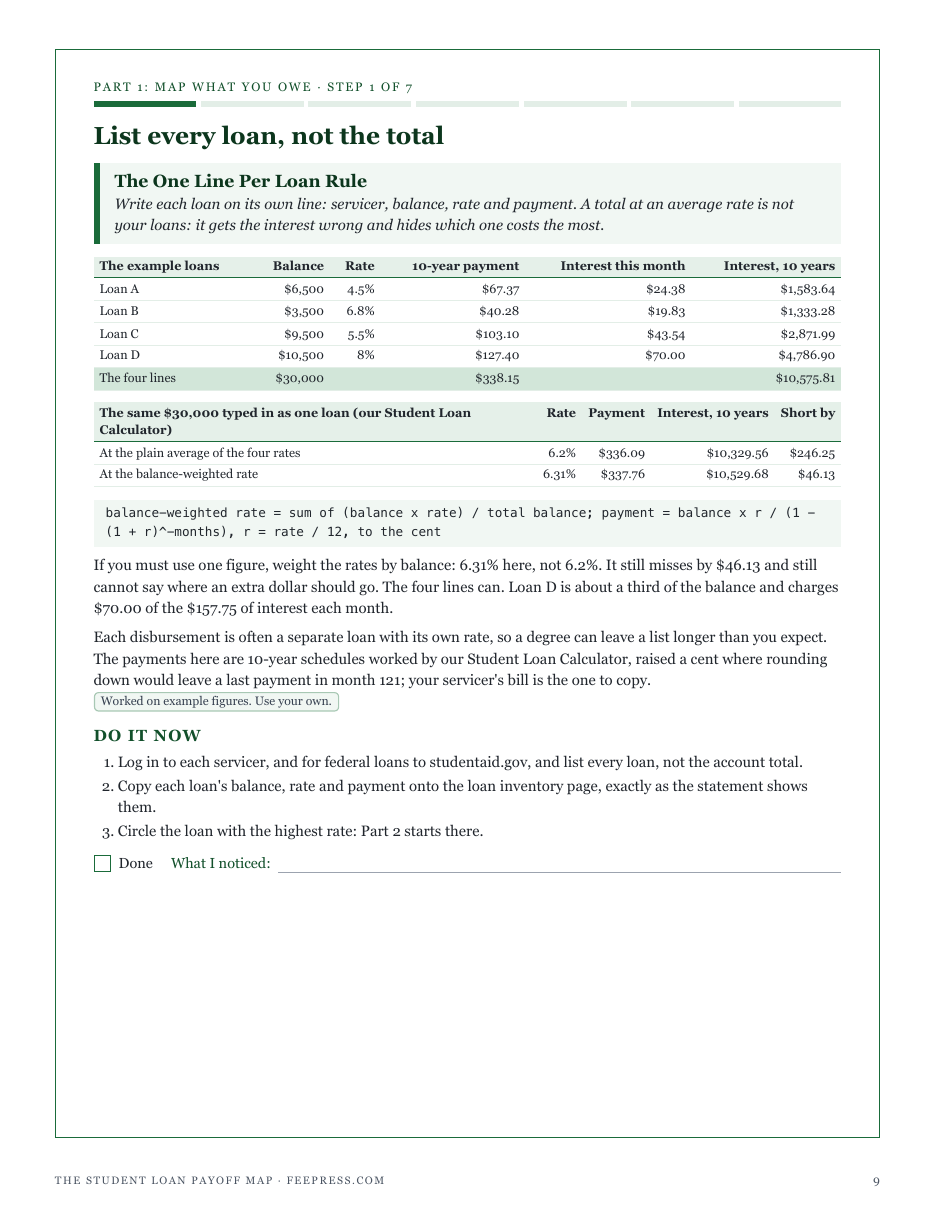
FeePress's calculators each work one loan at one rate, and most borrowers owe several, at several rates. Typed into a calculator as one total at their plain average rate, four example loans totaling $30,000 look $246.25 cheaper over 10 years than they are, and the total cannot say which loan an extra dollar should go to. The Student Loan Payoff Map puts every loan on its own line, checks each payment covers its interest (a payment that does not gets no payoff date), prices what unpaid interest costs once it is added to the balance, and turns next year's loan into the monthly payment it adds before it is signed. Then it orders the extra: on the example loans the same $100 a month saves $3,765.61 on the highest rate first and $3,037.25 on the smallest balance first, and a statement log checks the extra landed where you sent it. It is arithmetic and organization only: it recommends no lender, refinancing product or investment, and it states no federal program's rules or rates, which change often; program questions go to studentaid.gov and your loan servicer. The worked figures are examples. Included: 24 printable pages with seven steps, four working pages, a payment table and a quickstart, plus a personalised sheet worked from the numbers you enter in our calculators.
Look inside
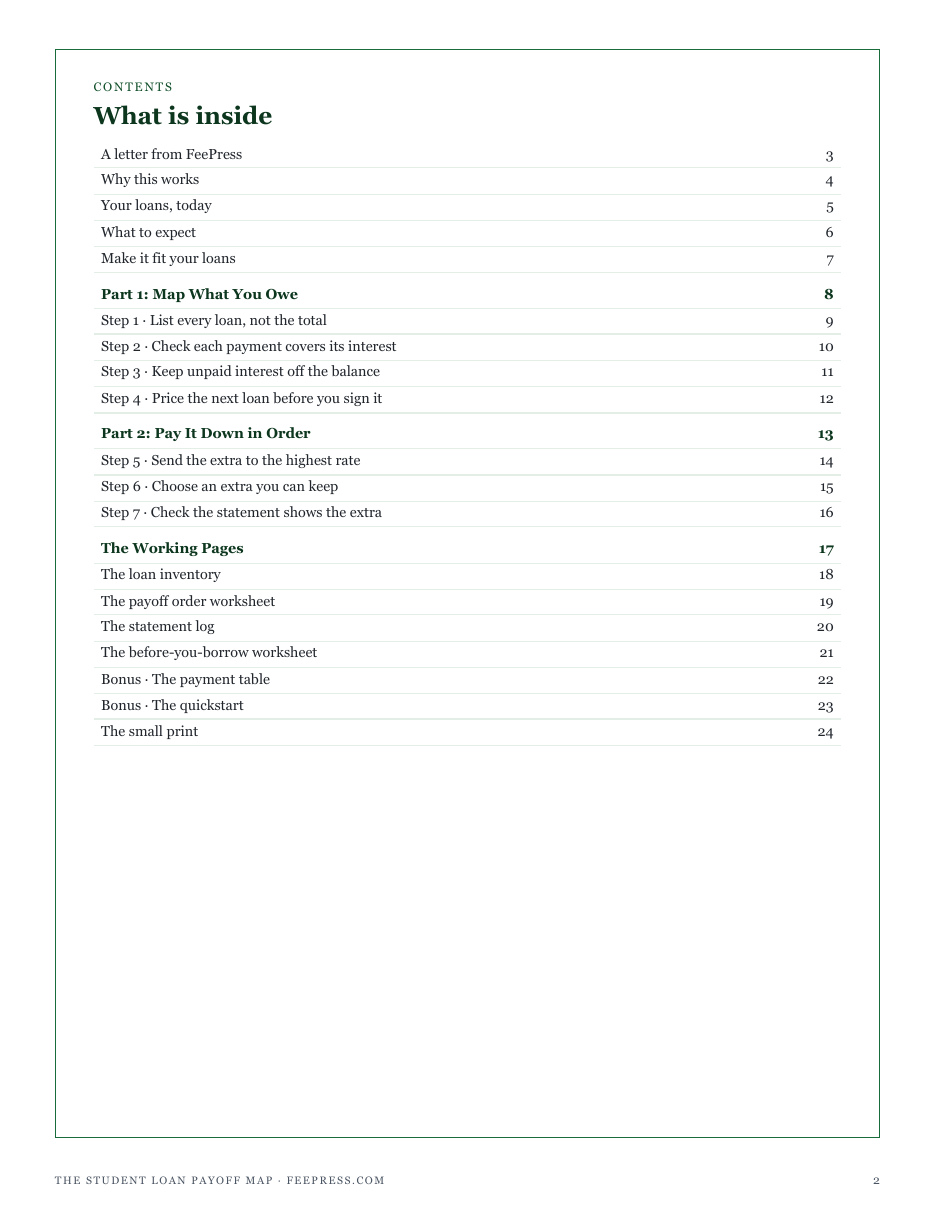
Two full pages from the map, exactly as printed. Click either to read it at full size before you decide.
What is in it
- The One Line Per Loan Rule: every loan listed with its own balance, rate and payment, and what a single total at an average rate gets wrong
- The Interest First Rule: interest per day and per month for each loan, and no payoff date for a payment that does not cover it
- The Capitalization Rule: what unpaid interest costs once it is added to the balance, and the two questions to ask your servicer
- The Borrow the Gap Rule: next year's full cost less gift aid, the family's share and work-study, priced as a monthly payment before you sign
- The Highest Rate First Rule: the extra sent to the highest rate, compared with smallest balance first and spreading it
- The Steady Extra Rule: a ladder of monthly extras, with the months and interest each one saves
- The Statement Check Rule: the principal each payment should retire at daily interest, and a written instruction for the extra
- Printable working pages: a loan inventory, a payoff order worksheet, a statement log and a before-you-borrow worksheet
- A payment table per $1,000 borrowed at a range of rates and terms, and a quickstart
- A personalised sheet worked from the numbers you enter in our calculators
- ✓ 24 printable pages
- ✓ 10 sections, worksheets and templates
- ✓ A second PDF worked out from the numbers you enter
- ✓ No account needed, just an email address
- ✓ Instant download; link valid 7 days
Price includes any taxes. Sold by GrabURL, who handle checkout and support. The charge appears on your statement as GrabURL.
The map picks up where the free Loan Payoff Estimator leaves off. The estimator takes one balance at one rate; the map lists every loan on its own line, checks that each payment covers its interest, and sends each extra dollar to the loan where it saves the most, with a statement log to check it landed. It prices the next loan before it is signed, from the College Cost Estimator and the Net Price Estimator, as the payment the Student Loan Calculatorsays it adds. It is arithmetic and organization only: it recommends no lender, refinancing product or investment, and it states no federal program's rules or rates, which change often. For repayment plans, forgiveness and rates, go to studentaid.gov and your loan servicer. The worked figures are examples; your loans are yours to fill in.